
Rediscover the authentic flavour
and nutritional benefits
of ancient flours.
The return of the stone mill for wholemeal flour:
an ancient milling system brought back to the modern era.
Stoneground is the wording that is increasingly read on the labels of flour bags highlighting
the old techniques and bringing back to us the memory of an old mill.
That’s not always the case!
There are very few old stone mills and they’re mostly obsolete, especially if we refer to the current
sanitation rules and to the performance expectations to achieve.
The truth is that today the modern version of the old mills is spreading, ennobled with the latest mechatronic technologies, guaranteeing the perfect control of the grinding parameters and assuring the result of a pure wholemeal flour where bran and germ are present without being too shredded, without the flour being heated (preserving the nutrional values) and its color modified.
The technique used is always the same as in the past: the wheat is conveyed to the center of the two millstones and from here,
passing through them, it is milled.
At the exit of the stone mill you will obtain a 100% wholemeal flour that, if sifted,
will give type “2” or type “1” flour.
What is the perfect flour?
That obtained by stone grinding or by conventional roller milling?
Wholemeal or whole wheat flour?
Wheat flour is identified as the product obtained by grinding and subsequent sieving.
No reference to the type of machinery used for grinding and so it could be either stone or cylindrical rollers.
Without forgetting that the quality of the flour starts from the beginning of the supply chain, therefore from the field.

Stone mill
FIND OUT MORE
The flour preserves intact its purity because germ and bran blend with the flour itself releasing its flavor and aroma while maintaining the important nutritional properties; this is the advantage of stone milling.
The flour is rich in fiber, minerals, vitamin B, vitamin E, proteins, and fats.
With stone milling type “00” flour cannot be produced because it is not possible to reduce the ash parameters caused by the germ and bran parts that remain present even if sifted.
The shelf life of wholemeal flour (containing germ, bran, and various nutritional contents) is more limited due to the germ presence.

Roller mill
FIND OUT MORE
With a roller mill you obtain a white flour with a very low ash content (00), as well as high capacities capable of meeting the needs of industry.
In this process whole wheat flour is obtained by mixing flour with bran, presetting the percentages. This is whole wheat flour.
What are the ashes in the flour?
The ashes are the mineral part and are mostly concentrated in the external part of the grain. The more the flour is refined, the less ashes it contains and vice versa, if the flour is less refined it contains more ashes.
This data is very important in the classification of flours:
| Type and denomination | Ashes Max |
| Type “00” wheat flour | 0,55 |
| Type “0” wheat flour | 0,65 |
| Type “1” wheat flour | 0,80 |
| Type “2” wheat flour | 0,95 |
| Whole wheat flour | 1,70 |
BioStoneMill, the electric stone mill.
It consists of two stones stacked on top of each other. The gap between the two stones can be adjusted to produce coarser or finer flour.
A precise and electronically controlled dosing ensures a consistent flow, proportionate to the speed of the stones, preventing clogging or a lack of cereal.
Specific grooves on the stones assist the grinding process; the shape and number of grooves, along with the speed of the active stone, are crucial for the quality of flour desired.
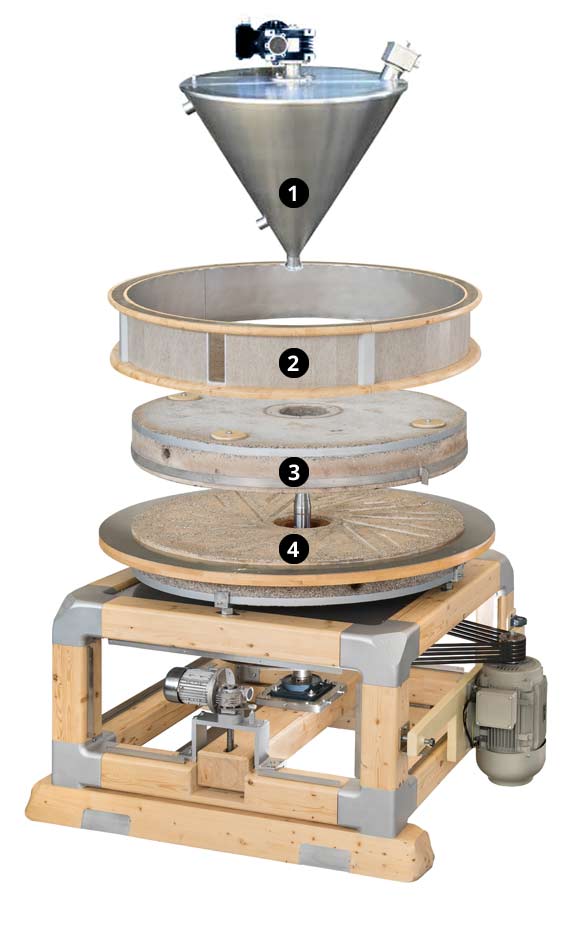

Hopper
The hopper that contains the cereal to be ground is positioned above the millstone case.

Millstone case
It’s the outer wall that encloses the millstones.

Upper millstone
The upper millstone rotates and is called the “active” stone.

Dormant millstone
The lower millstone remains stationary and is called the “dormant” stone.

The new techniques implement the traditional one.
The cereal grinding phase is implemented today with a preceding process called dehulling; with millstones in abrasive stone the first layers of bran are separated, thus removing the outer parts of the grain, those contaminated by external agents and therefore full of mycotoxins and chemical contaminants.
A little more about wheat.
What are the mycotoxins?
Mycotoxins are secondary metabolites produced by plant spores or food’s molding agents that, if ingested by animals or humans, could lead to acute or chronic diseases.
What is the germ?
It is the embryo, the nutritional part of the grain and is fundamental for the growth of the plant.
The germ contains polyunsaturated fats, B vitamins, minerals, and antioxidant phenolic compounds.

What is the endosperm?
The endosperm is found in the innermost part of the grain that contains starch and proteins and is the nourishment of the germ. Refined flours are obtained from it.
What is gluten?
Gluten is a lipoprotein that originates from the union, in the presence of water, of two types of proteins: gliadin and glutenin.
Gluten gives the dough cohesion and elasticity.